_ed.jpg)
First and foremost, let's talk more about the change process
“Change is hardest at the beginning, messiest in the middle and best at the end.”
--- Robin Sharma
Change is more than making physical updates to the home. It also involves helping the older adult accept the changes and modify their behavior. For example, giving someone a cane or shower chair does not guarantee they will use it. The “discussion” needs to include supporting the older adult to accept and follow the new safety plan.
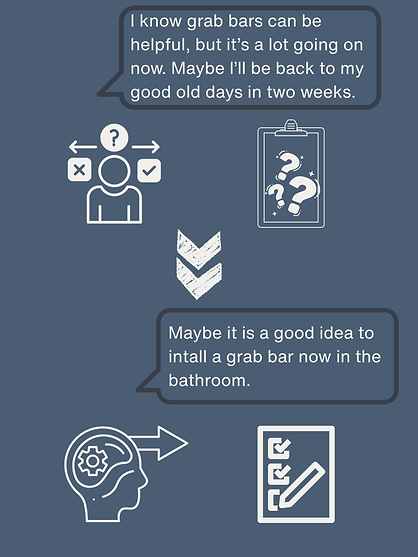
In Mary's situation, adding a grab bar in Irene's bathroom is the change that Mary is trying to make. Will that go as smooth as Mary saying "you need to change" and Irene responding "yes I do"? Probably not. Irene may feel hesitant or “resistant” to the change, which could leave Mary feeling frustrated. This tension may also affect their relationship. Let’s take a closer look at how change happens.
Many people think change happens in a straight, linear way. In reality, change is often a journey -- it can include bumps, pauses, and slow progress.
Assumptions
about change
.png)
VS.
Audio caption
What actually happens
.png)
Audio caption
What about resistance?
We often say: "oh my god, why is my uncle so resistant?" But it might not be the case. People are stubborn because their current situation is working for them in some way.
Irene needs to use a walker but the bathroom door is too narrow for it to fit. Mary is trying to convince her to install two grab bars. Irene is, however, unhappy. She says that she's fine and can hold onto the sink and the towel rack. Is she being stubborn or resistant? Maybe not! From her perspective, things are still working well enough, so she does not see a strong need to change right now.

Audio caption
It won't work if you try to "fix" people
You might feel skeptical about how resistance and stubbornness are described and think that people just need more "convincing". If you tried "fixing" people before, you know it doesn't work. Even when people say yes, they may not actually change what they do. For older adults, simply telling them what to do often leads to frustration, because it can take away their independence and sense of autonomy.
Mary's frustration with Irene is growing. She tries to reason, "holding onto random things is not safe in the bathroom." To threaten, "if you don't install grab bars, I'm not going to be bothered if you end up in hospital again." She begs, "I really need you to be safe, I can't take time off from work anymore." But Irene has responses to each of these approaches. Mary begins to feel like giving up, thinking, “why isn’t this working? I feel like I’ve tried everything.”

You're here
.png)
.png)